Keyte Group
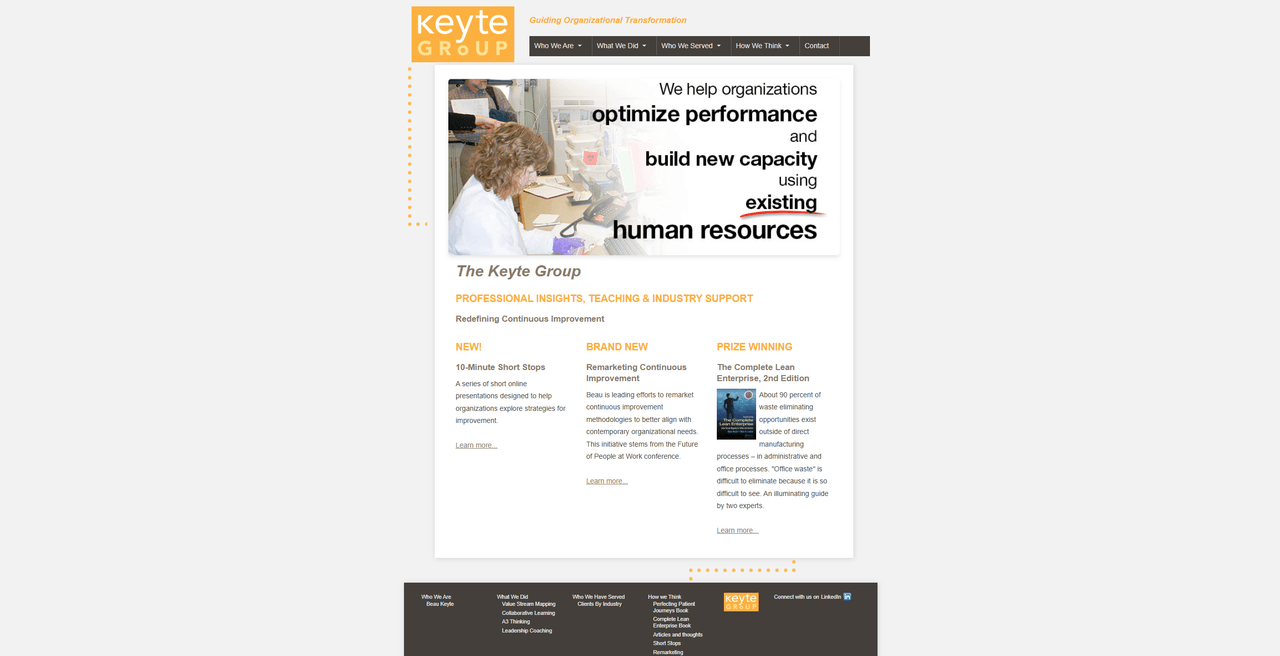
Keyte Group is an organizational transformation consulting firm with a published body of work — articles, papers, and teaching materials that practitioners across the field still use. The firm's host announced it was ending Concrete5 support, so that body of work needed a new home.
Keyte Group's goals were specific: keep the firm's contributions to the field online and accessible, and update the site to fit the current stage of the practice.
The project was a rescue migration in two stages — first off Concrete5 onto plain HTML and CSS to get the site safe, then an upgrade to Next.js for ease of updating — preserving the existing design throughout and adding analytics and SEO.
The Challenge with the Concrete5 Site
The driver was continuity, not a redesign. The first priority was to get the content out of Concrete5 and onto something with no CMS runtime to lose support for.
Once the site was safe as static HTML and CSS, the second stage addressed what the legacy platform had been leaving on the table: the technical SEO the old stack could not provide — modern meta tags, fast loads, mobile rendering — and an update path that no longer required developer involvement for small changes. The firm's reputation had earned its search visibility; the platform just needed to catch up.
The Brief
The project had four requirements:
- Migrate off Concrete5 before support for the platform ended
- Preserve the existing design and content throughout
- Keep publications and teaching materials online and accessible
- Add the analytics and search visibility the legacy stack lacked
What Was Built
Two-stage migration: First, the site was extracted from Concrete5 into plain HTML and CSS — design intact, content intact. Then it was rebuilt in Next.js (App Router) with TypeScript throughout, porting the content into clean static components and Markdown files so future updates are simple file edits.
Design preservation: The client's existing design was preserved closely — the visual language, color palette, and layout hierarchy that had been established were maintained. The goal was a modernization, not a rebrand.
Publications showcase: A dedicated section for the firm's articles, papers, and teaching materials — filterable and linkable, so years of contributions stay accessible.
GA4 implementation: Google Analytics 4 was set up from scratch, giving the site baseline traffic and page analytics for the first time.
SEO optimization: Meta titles, meta descriptions, Open Graph tags, structured data (schema.org), and canonical URL configuration added across all pages. Search Console was connected and verified.
Results
- The site was migrated off Concrete5 to a modern, supported stack.
- The existing design was preserved through both stages of the migration.
- GA4 was configured, and Search Console was connected and verified.
- The firm's body of work remains online and findable, and site updates are simple file edits.
This is a representative example of what Next.js development and GA4 implementation look like when applied to a legacy CMS migration — years of a firm's work carried forward onto a platform that will not lose support underneath it. Keyte Group is a DC-area firm; see web development in Northern Virginia and DC.